What Are the General Characteristics of Prechristian Northern European Art?
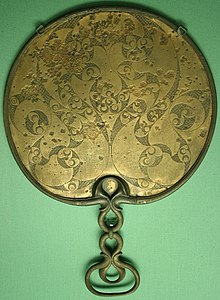
The reverse side of a British bronze mirror, l BC – l AD, showing the spiral and trumpet decorative theme of the late "Insular" La Tène style

Celtic art is associated with the peoples known every bit Celts; those who spoke the Celtic languages in Europe from pre-history through to the mod period, as well as the art of aboriginal peoples whose language is uncertain, only have cultural and stylistic similarities with speakers of Celtic languages.
Celtic art is a difficult term to define, covering a huge area of time, geography and cultures. A case has been fabricated for creative continuity in Europe from the Statuary Age, and indeed the preceding Neolithic age; however archaeologists more often than not employ "Celtic" to refer to the culture of the European Iron Age from around 1000 BC onwards, until the conquest by the Roman Empire of almost of the territory concerned, and art historians typically begin to talk about "Celtic fine art" only from the La Tène period (broadly fifth to 1st centuries BC) onwards.[1] Early Celtic art is another term used for this flow, stretching in U.k. to near 150 AD.[two] The Early Medieval art of United kingdom and Ireland, which produced the Book of Kells and other masterpieces, and is what "Celtic art" evokes for much of the full general public in the English-speaking globe, is called Insular fine art in art history. This is the best-known part, simply not the whole of, the Celtic art of the Early Center Ages, which too includes the Pictish art of Scotland.[3]
Both styles absorbed considerable influences from non-Celtic sources, but retained a preference for geometrical decoration over figurative subjects, which are frequently extremely stylised when they practice appear; narrative scenes only announced under outside influence.[4] Energetic circular forms, triskeles and spirals are characteristic. Much of the surviving material is in precious metal, which no dubiety gives a very unrepresentative pic, but apart from Pictish stones and the Insular high crosses, large monumental sculpture, even with decorative carving, is very rare. Maybe the few continuing male person figures found, similar the Warrior of Hirschlanden and the so-called "Lord of Glauberg", were originally common in forest.
Also covered past the term is the visual art of the Celtic Revival (on the whole more notable for literature) from the 18th century to the modern era, which began every bit a conscious effort past Modernistic Celts, mostly in the British Isles, to express self-identification and nationalism, and became popular well beyond the Celtic nations, and whose way is still electric current in various popular forms, from Celtic cross funerary monuments to interlace tattoos. Coinciding with the beginnings of a coherent archaeological understanding of the earlier periods, the style self-consciously used motifs closely copied from works of the earlier periods, more oftentimes the Insular than the Iron Age. Another influence was that of late La Tène "vegetal" art on the Art Nouveau movement.
Typically, Celtic art is ornamental, avoiding straight lines and just occasionally using symmetry, without the imitation of nature central to the classical tradition, often involving circuitous symbolism. Celtic art has used a diversity of styles and has shown influences from other cultures in their knotwork, spirals, cardinal patterns, lettering, zoomorphics, plant forms and human figures. As the archaeologist Catherine Johns put it: "Mutual to Celtic art over a wide chronological and geographical span is an exquisite sense of balance in the layout and development of patterns. Curvilinear forms are set out so that positive and negative, filled areas and spaces form a harmonious whole. Control and restraint were exercised in the use of surface texturing and relief. Very circuitous curvilinear patterns were designed to embrace precisely the most awkward and irregularly shaped surfaces".[5]
Background [edit]
The ancient peoples now called "Celts" spoke a group of languages that had a mutual origin in the Indo-European linguistic communication known equally Common Celtic or Proto-Celtic. This shared linguistic origin was once widely accustomed past scholars to signal peoples with a common genetic origin in southwest Europe, who had spread their culture by emigration and invasion. Archaeologists identified diverse cultural traits of these peoples, including styles of art, and traced the culture to the before Hallstatt culture and La Tène civilization. More contempo genetic studies have indicated that diverse Celtic groups practice not all have shared beginnings, and take suggested a diffusion and spread of the culture without necessarily involving significant motion of peoples.[6] The extent to which "Celtic" linguistic communication, civilisation and genetics coincided and interacted during prehistoric periods remains very uncertain and controversial.

Celtic fine art is associated with the peoples known as Celts; those who spoke the Celtic languages in Europe from pre-history through to the mod period, as well as the fine art of aboriginal peoples whose language is uncertain, but have cultural and stylistic similarities with speakers of Celtic languages.
The term "Celt" was used in classical times every bit a synonym for the Gauls (Κελτοι, Celtae). Its English form is modern, attested from 1607. In the late 17th century the piece of work of scholars such as Edward Lhuyd brought academic attention to the historic links betwixt Gaulish and the Brythonic—and Goidelic—speaking peoples, from which betoken the term was practical non but to continental Celts but those in Great britain and Ireland. So in the 18th century the interest in "primitivism", which led to the idea of the "noble barbarous", brought a moving ridge of enthusiasm for all things Celtic and Druidic. The "Irish revival" came afterwards the Catholic Emancipation Deed of 1829 as a conscious try to demonstrate an Irish gaelic national identity, and with its counterpart in other countries subsequently became the "Celtic Revival".
Pre-Celtic periods [edit]
The earliest archaeological culture that is conventionally termed Celtic, the Hallstatt culture (from "Hallstatt C" onwards), comes from the early European Atomic number 26 Age, c. 800–450 BC. Nonetheless, the art of this and later periods reflects considerable continuity, and some long-term correspondences, with earlier art from the same regions, which may reflect the accent in recent scholarship on "Celticization" past acculturation amid a relatively static population, as opposed to older theories of migrations and invasions. Megalithic art across much of the earth uses a similar mysterious vocabulary of circles, spirals and other curved shapes, only information technology is striking that the virtually numerous remains in Europe are the large monuments, with many rock drawings left by the Neolithic Boyne Valley civilization in Ireland, within a few miles of centres for Early Medieval Insular art some 4,000 years subsequently. Other centres such equally Brittany are also in areas that remain defined as Celtic today. Other correspondences are between the gold lunulas and large collars of Bronze Age Republic of ireland and Europe and the torcs of Iron Age Celts, all elaborate ornaments worn circular the cervix. The trumpet shaped terminations of various types of Statuary Age Irish jewellery are also reminiscent of motifs pop in later Celtic decoration.
Iron Age; Early on Celtic art [edit]

Unlike the rural culture of Iron Age inhabitants of the modern "Celtic nations", Continental Celtic civilization in the Fe Age featured many large fortified settlements, some very large, for which the Roman word for "town", oppidum, is now used. The elites of these societies had considerable wealth, and imported big and expensive, sometimes bluntly flashy, objects from neighbouring cultures, some of which have been recovered from graves. The work of the German émigré to Oxford, Paul Jacobsthal, remains the foundation of the study of the art of the menstruation, specially his Early Celtic Art of 1944.[viii]
The Halstatt culture produced art with geometric ornament, only marked by patterns of straight lines and rectangles rather than curves; the patterning is often intricate, and fills all the space bachelor, and at least in this respect looks forrard to later Celtic styles. Linguists are generally satisfied that the Halstatt culture originated among people speaking Celtic languages, simply fine art historians oft avert describing Halstatt art equally "Celtic".
As Halstatt society became increasingly rich and, despite existence entirely land-locked in its principal zone, linked by trade to other cultures, especially in the Mediterranean, imported objects in radically unlike styles brainstorm to announced, even including Chinese silks. A famous example is the Greek krater from the Vix Grave in Burgundy, which was made in Magna Graecia (the Greek south of Italy) c. 530 BC, some decades before information technology was deposited. It is a huge bronze wine-mixing vessel, with a capacity of 1,100 litres.[9] Some other huge Greek vessel in the Hochdorf Chieftain's Grave is decorated with three recumbent lions lying on the rim, one of which is a replacement by a Celtic creative person that makes little attempt to copy the Greek mode of the others.[10] Forms characteristic of Hallstatt culture can exist found as far from the master Fundamental European area of the culture as Ireland, just mixed with local types and styles.[11]
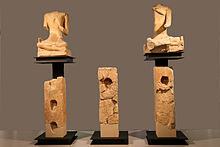
Sculpture from Roquepertuse, including "skull-niches" and seated figures
Figures of animals and humans do announced, especially in works with a religious chemical element. Among the most spectacular objects are "cult wagons" in statuary, which are big wheeled trolleys containing crowded groups of standing figures, sometimes with a large basin mounted on a shaft at the eye of the platform, probably for offerings to gods; a few examples have been institute in graves. The figures are relatively simply modelled, without much success in detailed anatomical naturalism compared to cultures farther south, but ofttimes achieving an impressive result. There are besides a number of single stone figures, often with a "foliage crown" — two flattish rounded projections, "resembling a pair of swollen commas", rising behind and to the side of the head, probably a sign of divinity.[12]
Human heads alone, without bodies, are far more than common, often appearing in relief on all sorts of objects. In the La Tène menstruum faces often (along with bird's heads) emerge from ornamentation that at first looks abstract, or plant-based. Games are played with faces that alter when they are viewed from dissimilar directions. In figures showing the whole torso, the head is frequently over-large. There is evidence that the human head had a special importance in Celtic religious beliefs.[xiii]
The most elaborate ensembles of stone sculpture, including reliefs, come from southern France, at Roquepertuse and Entremont, close to areas colonized past the Greeks. It is possible that similar groups in wood were widespread. Roquepertuse seems to accept been a religious sanctuary, whose stonework includes what are thought to have been niches where the heads or skulls of enemies were placed. These are dated to the 3rd century BC, or sometimes earlier.
In full general, the number of high-quality finds is non large, particularly when compared to the number of survivals from the contemporary Mediterranean cultures, and there is a very clear partition between elite objects and the much plainer goods used by the majority of the people. There are many torcs and swords (the La Tène site produced over iii,000 swords, apparently votive offerings[xiv]), just the best-known finds, like the Czech head above, the shoe plaques from Hochdorf and the Waterloo Helmet, often have no similar other finds for comparison. Conspicuously religious content in art is rare, only little is known about the significance that most of the decoration of applied objects had for its makers, and the bailiwick and significant of the few objects without a applied function is equally unclear.
Hallstatt gallery [edit]
-

Belatedly Hallstatt gold neckband from Austria, c. 550 BC
La Tène style [edit]

About 500 BC the La Tène style, named after a site in Switzerland, appeared rather suddenly, coinciding with some kind of societal upheaval that involved a shift of the major centres in a due north-westerly management. The central expanse where rich sites are especially found is in northern France and western Germany, but over the adjacent three centuries the way spread very widely, equally far as Republic of ireland, Italia[15] and mod Hungary. In some places the Celts were ambitious raiders and invaders, but elsewhere the spread of Celtic fabric civilisation may have involved only pocket-sized movements of people, or none at all. Early on La Tène manner adapted ornamental motifs from strange cultures into something distinctly new; the complicated brew of influences including Scythian art and that of the Greeks and Etruscans among others. The occupation by the Persian Achaemenid Empire of Thrace and Macedonia around 500 BC is a cistron of uncertain importance.[xvi] La Tène fashion is "a highly stylised curvilinear art based mainly on classical vegetable and leafage motifs such every bit leafy palmette forms, vines, tendrils and lotus flowers together with spirals, Southward-scrolls, lyre and trumpet shapes".[17]
The about lavish objects, whose imperishable materials tend to mean they are the best preserved other than pottery, do not refute the stereotypical views of the Celts that are found in classical authors, where they are represented as mainly interested in feasting and fighting, as well as ostentatious brandish. Society was dominated past a warrior aristocracy and military equipment, even if in ceremonial versions, and containers for drink, represent most of the largest and near spectacular finds, other than jewellery.[18] Unfortunately for the archaeologist, the rich "princely" burials feature of the Hallstatt period greatly reduce, at least partly considering of a modify from inhumation burials to cremation.[19]
The torc was patently a key marker of status and very widely worn, in a range of metals no dubiety reflecting the wealth and status of the owner. Bracelets and armlets were also common.[20] An exception to the full general lack of depictions of the human figure, and of the failure of wooden objects to survive, are certain water sites from which large numbers of small carved figures of trunk parts or whole human figures take been recovered, which are causeless to be votive offerings representing the location of the ailment of the supplicant. The largest of these, at Source-de-la-Roche, Chamalières, France, produced over 10,000 fragments, mostly at present at Clermont-Ferrand.[21]

Statuary plumbing fixtures from France in the "vegetal" way
Several phases of the style are distinguished, under a diversity of names, including numeric (De Navarro) and alphabetic series. Generally, there is broad understanding on how to demarcate the phases, but the names used differ, and that they followed each other in chronological sequence is now much less certain. In a version of Jacobsthal's sectionalisation, the "early on" or "strict" phase, De Navarro I, where the imported motifs remain recognisable, is succeeded by the "vegetal", "Continuous Vegetal", "Waldalgesheim style", or De Navarro Ii, where ornament is "typically dominated by continuously moving tendrils of various types, twisting and turning in restless move across the surface".[12]
After virtually 300 BC the manner, at present De Navarro 3, tin can be divided into "plastic" and "sword" styles, the latter mainly plant on scabbards and the erstwhile featuring decoration in high relief. One scholar, Vincent Megaw, has divers a "Disney style" of drawing-like fauna heads within the plastic style, and besides an "Oppida catamenia art, c 125–c fifty BC". De Navarro distinguishes the "insular" fine art of the British Isles, up to about 100 BC, as Mode IV, followed by a Fashion V,[22] and the separateness of Insular Celtic styles is widely recognised.[23]

The often spectacular art of the richest earlier Continental Celts, before they were conquered past the Romans, often adopted elements of Roman, Greek and other "strange" styles (and possibly used imported craftsmen) to decorate objects that were distinctively Celtic. And so a torc in the rich Vix Grave terminates in big assurance in a way found in many others, but here the ends of the band are formed as the paws of a lion or similar animate being, without making a logical connexion to the balls, and on the outside of the ring 2 tiny winged horses sit on finely worked plaques. The result is impressive but somewhat incongruous compared to an as ostentatious British torc from the Snettisham Hoard that is made 400 years later and uses a style that has matured and harmonized the elements making it upwardly. The 1st century BC Gundestrup cauldron, is the largest surviving slice of European Fe Age argent (diameter 69 cm, height 42 cm), but though much of its iconography seems clearly to exist Celtic, much of it is not, and its manner is much debated; it may well exist of Thracian industry. To farther confuse matters, information technology was found in a bog in n Denmark.[24] The Agris Helmet in golden leaf over bronze clearly shows the Mediterranean origin of its decorative motifs.
By the tertiary century BC Celts began to produce coinage, imitating Greek and later on Roman types, at first fairly closely, just gradually allowing their own taste to take over, then that versions based on sober classical heads sprout huge wavy masses of pilus several times larger than their faces, and horses become formed of a series of vigorously curved elements.
A class patently unique to southern U.k. was the mirror with a handle and complex decoration, mostly engraved, on the dorsum of the statuary plate; the front side being highly polished to act as the mirror. Each of the more than fifty mirrors constitute has a unique design, merely the essentially circular shape of the mirror presumably dictated the sophisticated abstract curvilinear motifs that boss their ornament.[25]
Despite the importance of Ireland for Early Medieval Celtic art, the number of artefacts showing La Tène style institute in Ireland is small, though they are often of very high quality. Some aspects of Hallstatt metalwork had appeared in Ireland, such as scabbard chapes, just the La Tène style is not plant in Republic of ireland before some bespeak between 350 and 150 BC, and until the latter engagement is mostly found in mod Northern Ireland, notably in a series of engraved scabbard plates. Thereafter, despite Ireland remaining exterior the Roman Empire that engulfed the Continental and British Celtic cultures, Irish art is subject to continuous influence from outside, through trade and probably periodic influxes of refugees from United kingdom of great britain and northern ireland, both before and after the Roman invasion. It remains uncertain whether some of the most notable objects constitute from the menstruum were made in Ireland or elsewhere, as far away equally Germany and Egypt in specific cases.[26]

Just in Scotland and the western parts of Britain where the Romans and later on the Anglo-Saxons were largely held back, versions of the La Tène style remained in use until it became an important component of the new Insular way that developed to meet the needs of newly Christianized populations. Indeed, in northern England and Scotland almost finds mail-date the Roman invasion of the due south.[27] However, while there are fine Irish gaelic finds from the 1st and 2nd centuries, there is little or nothing in La Tène mode from the tertiary and 4th centuries, a period of instability in Republic of ireland.[28]
After the Roman conquests, some Celtic elements remained in popular art, especially Ancient Roman pottery, of which Gaul was actually the largest producer, mostly in Italian styles, but also producing work in local taste, including figurines of deities and wares painted with animals and other subjects in highly formalized styles. Roman Great britain produced a number of items using Roman forms such as the fibula but with La Tène mode ornament, whose dating tin be hard,[29] for example a "hinged contumely collar" from around the time of the Roman conquest shows Celtic ornament in a Roman context.[xxx] Britain also made more utilize of enamel than most of the Empire, and on larger objects, and its development of champlevé technique was probably important to the later Medieval art of the whole of Europe, of which the energy and liberty derived from Insular ornamentation was an important element. Enamel decoration on penannular brooches, "dragonesque" brooches,[31] and hanging bowls appears to demonstrate a continuity in Celtic decoration between works like the Staffordshire Moorlands Pan and the flowering of Christian Insular art from the sixth century onwards.
- Continental examples
-

Gold mounts on a basin, adapting Mediterranean motifs, Germany, c. 420BC
-
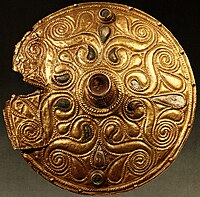
Disc brooch, France, 4th century BC
- British examples
-

Bronze mountain in British "Disney mode", 10 cm high, 1st century Advertising
Early Middle Ages [edit]
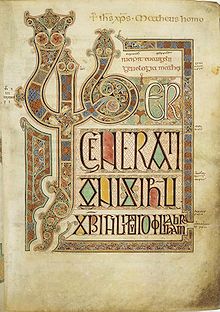
Mail-Roman Republic of ireland and Great britain [edit]
Celtic fine art in the Center Ages was practiced by the peoples of Ireland and parts of Uk in the 700-twelvemonth menses from the Roman withdrawal from Britain in the fifth century, to the establishment of Romanesque fine art in the 12th century. Through the Hiberno-Scottish mission the way was influential in the development of art throughout Northern Europe.
In Ireland an unbroken Celtic heritage existed from before and throughout the Roman era of United kingdom of great britain and northern ireland, which had never reached the island, though in fact Irish objects in La Tène style are very rare from the Belatedly Roman period. The fifth to 7th centuries were a continuation of late Fe Age La Tène art, with also many signs of the Roman and Romano-British influences that had gradually penetrated there.[32] With the arrival of Christianity, Irish art was influenced past both Mediterranean and Germanic traditions, the latter through Irish gaelic contacts with the Anglo-Saxons, creating what is called the Insular or Hiberno-Saxon style, which had its gilded historic period in the 8th and early 9th centuries before Viking raids severely disrupted monastic life. Late in the menses Scandinavian influences were added through the Vikings and mixed Norse-Gael populations, then original Celtic work came to end with the Norman invasion in 1169–1170 and the subsequent introduction of the general European Romanesque style.[ citation needed ]
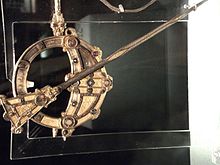
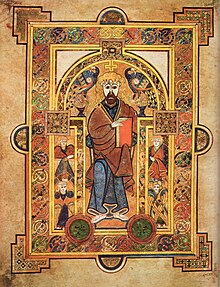
In the seventh and 9th centuries Irish Celtic missionaries travelled to Northumbria in United kingdom and brought with them the Irish tradition of manuscript illumination, which came into contact with Anglo-Saxon metalworking knowledge and motifs. In the monasteries of Northumbria these skills fused and were probably transmitted back to Scotland and Republic of ireland from at that place, also influencing the Anglo-Saxon art of the rest of England. Some of the metalwork masterpieces created include the Tara Brooch, the Ardagh Chalice and the Derrynaflan Chalice. New techniques employed were grid and chip carving, while new motifs included interlace patterns and animal ornament. The Book of Durrow is the primeval consummate insular script illuminated Gospel Volume and by about 700, with the Lindisfarne Gospels, the Hiberno-Saxon fashion was fully developed with detailed carpet pages that seem to glow with a wide palette of colours. The art form reached its peak in the late 8th century with the Volume of Kells, the nearly elaborate Insular manuscript. Anti-classical Insular creative styles were carried to mission centres on the Continent and had a continuing bear upon on Carolingian, Romanesque and Gothic art for the rest of the Eye Ages.
In the ninth and 11th century plain argent became a popular medium in Anglo-Saxon England, probably because of the increased amount in circulation due to Viking trading and raiding, and it was during this fourth dimension a number of magnificent silverish penannular brooches were created in Ireland. Around the same time manuscript production began to decline, and although it has ofttimes been blamed on the Vikings, this is debatable given the pass up began before the Vikings arrived. Sculpture began to flourish in the grade of the "high cantankerous", large rock crosses that held biblical scenes in carved relief. This art form reached its apex in the early tenth century and has left many fine examples such as Muiredach'due south Cross at Monasterboice and the Ahenny High Cross.
The impact of the Vikings on Irish art is not seen until the late 11th century when Irish metal work begins to imitate the Scandinavian Ringerike and Urnes styles, for case the Cross of Cong and Shrine of Manchan. These influences were constitute not just in the Norse center of Dublin, but throughout the countryside in rock monuments such every bit the Dorty Cantankerous at Kilfenora and crosses at the Rock of Cashel.[33]
Some Insular manuscripts may have been produced in Wales, including the eighth century Lichfield Gospels and Hereford Gospels.[34] The late Insular Ricemarch Psalter from the 11th century was certainly written in Wales, and as well shows stiff Viking influence.
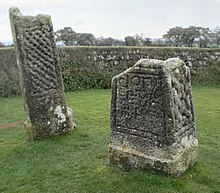
Art from celebrated Dumnonia, modern Cornwall, Devon, Somerset and Brittany on the Atlantic seaboard is now fairly sparsely attested and hence less well known as these areas afterwards became incorporated into England (and France) in the medieval and Early Modern flow.[35] However archaeological studies at sites such every bit Cadbury Castle, Somerset,[36] Tintagel,[37] and more recently at Ipplepen[38] indicate a highly sophisticated largely literate lodge with strong influence and connections with both the Byzantine Mediterranean likewise as the Atlantic Irish, and British in Wales and the 'Former Due north'. Many crosses, memorials and tombstones such as King Doniert'southward Stone,[39] the Drustanus rock and the notorious Artognou stone bear witness evidence for a surprisingly cosmopolitan sub-Roman population speaking and writing in both Brittonic and Latin and with at least some knowledge of Ogham indicated past several extant stones in the region. Breton and particularly Cornish manuscripts are exceedingly rare survivals but include the Bodmin manumissions[40] demonstrating a regional form of the Insular style.
Picts (Scotland) [edit]
From the 5th to the mid-9th centuries, the art of the Picts is primarily known through rock sculpture, and a smaller number of pieces of metalwork, often of very high quality; in that location are no known illuminated manuscripts. The Picts shared modern Scotland with a zone of Irish cultural influence on the w declension, including Iona, and the Anglo-Saxon kingdom of Northumbria to the due south. Subsequently Christianization, Insular styles heavily influenced Pictish art, with interlace prominent in both metalwork and stones.
The heavy silver Whitecleuch Chain has Pictish symbols on its terminals, and appears to be an equivalent to a torc. The symbols are also plant on plaques from the Norrie's Law hoard. These are thought to be relatively early pieces. The St Ninian's Isle Treasure of silver penannular brooches, bowls and other items comes from off the coast of Pictland and is often regarded as mostly of Pictish industry, representing the best survival of Late Pictish metalwork, from well-nigh 800 AD.
Pictish stones are assigned by scholars to 3 classes. Class I Pictish stones are unshaped standing stones incised with a serial of about 35 symbols which include abstract designs (given descriptive names such as crescent and V-rod, double disc and Z-rod, 'blossom' and and so on by researchers); carvings of recognisable animals (balderdash, eagle, salmon, adder and others), as well as the Pictish Animate being, and objects from daily life (a comb, a mirror). The symbols nigh always occur in pairs, with in about 1-third of cases the addition of the mirror, or mirror and comb, symbol, beneath the others. This is often taken to symbolise a woman. Autonomously from i or two outliers, these stones are constitute exclusively in north-e Scotland from the Firth of Along to Shetland. Good examples include the Dunnichen and Aberlemno stones (Angus), and the Brandsbutt and Tillytarmont stones (Aberdeenshire).
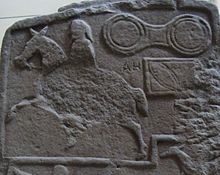
Course 2 stones are shaped cross-slabs carved in relief, or in a combination of incision and relief, with a prominent cross on one, or in rare cases 2, faces. The crosses are elaborately busy with interlace, key-pattern or scrollwork, in the Insular style. On the secondary face of the rock, Pictish symbols appear, often themselves elaborately decorated, accompanied by figures of people (notably horsemen), animals both realistic and fantastic, and other scenes. Hunting scenes are common, Biblical motifs less and so. The symbols often announced to 'label' 1 of the human figures. Scenes of boxing or gainsay betwixt men and fantastic beasts may be scenes from Pictish mythology. Good examples include slabs from Dunfallandy and Meigle (Perthshire), Aberlemno (Angus), Nigg, Shandwick and Hilton of Cadboll (Easter Ross).
Class III stones are in the Pictish style, but lack the characteristic symbols. Most are cross-slabs, though in that location are also recumbent stones with sockets for an inserted cross or modest cross-slab (eastward.one thousand. at Meigle, Perthshire). These stones may date largely to after the Scottish takeover of the Pictish kingdom in the mid 9th century. Examples include the sarcophagus and the large collection of cantankerous-slabs at St Andrews (Fife).
The following museums have important collections of Pictish stones: Meigle (Perthshire), St Vigeans (Angus) and St Andrew's Cathedral (Fife) (all Historic Scotland), the Museum of Scotland, Edinburgh (which also exhibits almost all the major pieces of surviving Pictish metalwork), the Meffan Establish, Forfar (Angus), Inverness Museum, Groam House Museum, Rosemarkie and Tarbat Discovery Centre, Portmahomack (both Easter Ross) and The Orkney Museum in Kirkwall.
Celtic revival [edit]
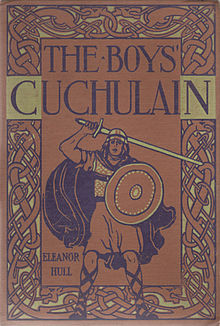
The revival of interest in Celtic visual art came erstwhile afterwards than the revived interest in Celtic literature. By the 1840s reproduction Celtic brooches and other forms of metalwork were fashionable, initially in Dublin, but later in Edinburgh, London and other countries. Interest was stimulated by the discovery in 1850 of the Tara Brooch, which was seen in London and Paris over the next decades. The late 19th century reintroduction of monumental Celtic crosses for graves and other memorials has arguably been the most enduring aspect of the revival, one that has spread well exterior areas and populations with a specific Celtic heritage. Interlace typically features on these and has also been used equally a mode of architectural decoration, especially in America around 1900, by architects such equally Louis Sullivan, and in stained glass and wall stenciling by Thomas A. O'Shaughnessy, both based in Chicago with its big Irish-American population. The "plastic mode" of early on Celtic fine art was i of the elements feeding into Art Nouveau decorative style, very consciously so in the piece of work of designers like the Manxman Archibald Knox, who did much piece of work for Liberty & Co.
The Craft Movement in Ireland embraced the Celtic way early, but began to back away in the 1920s. The governor of the National Gallery of Ireland, Thomas Bodkin, writing in The Studio magazine in 1921, drew attending to the decline in Celtic decoration in the Sixth Exhibition of the Arts and crafts Order of Republic of ireland said, "National art all over the earth has burst long agone, the narrow boundaries within which information technology is cradled, and grows more than cosmopolitan in spirit with each succeeding generation." George Atkinson, writing the foreword to the catalogue of that same exhibit emphasized the club'southward disapproval of any undue emphasis on Celtic ornament at the expense of good design. "Special pleading on behalf of the national traditional ornament is no longer justifiable."The mode had served the nationalist cause as an keepsake of a singled-out Irish culture, simply soon intellectual fashions abandoned Celtic art as nostalgically looking backwards.[41]
Interlace, which is nonetheless seen as a "Celtic" form of decoration—somewhat ignoring its Germanic origins and equally prominent place in Anglo-Saxon and Scandinavian medieval art—has remained a motif in many forms of popular design, specially in Celtic countries, and to a higher place all Ireland, where information technology remains a national manner signature. In contempo decades it has been used worldwide in tattoos, and in various contexts and media in fantasy works with a quasi-Dark Ages setting. The Secret of Kells is an animated characteristic movie of 2009 set during the creation of the Volume of Kells which makes much utilize of Insular design.
Past the 1980s a new Celtic Revival had begun, which continues to this day. Oft this late 20th-century motility is referred to every bit the Celtic Renaissance.[42] By the 1990s the number of new artists, craftsmen, designers and retailers specializing in Celtic jewelry and crafts was rapidly increasing. The Celtic Renaissance has been an international phenomenon, with participants no longer confined to just the Old-Globe Celtic countries.[43]
June 9 was designated International Day of Celtic Art in 2017 by a groups of gimmicky Celtic artists and enthusiasts. The twenty-four hours is an occasion for exhibits, promotions, workshops and demonstrations.[44]
Celtic art types and terms [edit]
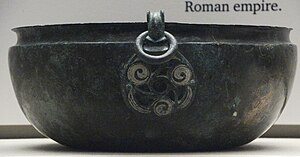
- Hanging bowl. According to the traditional theory, these were created past Celtic craftsmen during the fourth dimension of the Anglo-Saxon conquests of England. They were based on a Roman design, commonly fabricated of copper alloy with 3 or 4 suspension loops along the top rim, from which they were designed to be hung, peradventure from roof-beams or within a tripod. Their art-historical interest mainly derives from the round decorated plaques, ofttimes with enamel, that most accept forth their rims. Some of the finest examples are establish in the hoard at Sutton Hoo (625) which are enamelled. The noesis of their manufacture spread to Scotland and Ireland in the eighth century. However, although their styles continue popular Romano-British traditions, the supposition that they were made in Ireland is now questioned.
- Carpet page. An illuminated manuscript page decorated entirely in ornamentation. In Hiberno-Saxon tradition this was a standard feature of Gospel books, with one page as an introduction to each Gospel. Usually made in a geometric or interlace pattern, oftentimes framing a central cross. The earliest known example is the 7th century Bobbio Orosius.
- High cross. A alpine rock standing cantankerous, usually of Celtic cross grade. Decoration is abstract often with figures in carved relief, particularly crucifixions, just in some cases circuitous multi-scene schemes. Most common in Ireland, but also in Great Britain and near continental mission centres.
- Pictish stone. A cross-slab—a rectangular slab of rock with a cross carved in relief on the slab face, with other pictures and shapes carved throughout. Organised into three Classes, based on the period of origin.
- Insular fine art or the Hiberno-Saxon style, from the 6th to ninth centuries. The fusion of pre-Christian Celtic and Anglo-Saxon metalworking styles, practical to the new form of the religious illuminated manuscript, likewise as sculpture and secular and church metalwork. Likewise includes influences from mail-classical Europe, and after Viking decorative styles. The summit of the way in manuscripts occurred when Irish Celtic missionaries traveled to Northumbria in the 7th and 8th centuries. Produced some of the nearly outstanding Celtic art of the Eye Ages in illuminated manuscripts, metalworking and sculpture.
- Celtic calendar. The oldest material Celtic calendar is the fragmented Gaulish Coligny agenda from the 1st century BC or AD.
Come across also [edit]
- List of Hiberno-Saxon illustrated manuscripts
- Gundestrup cauldron
- Celtic maze
- Celtic blue
Notes [edit]
- ^ Megaws, for example; see their introductory section, where they explicate the situation & that their article will only comprehend the La Tène menstruum.
- ^ "Technologies of Enchantment: Early Celtic Art in Britain". British Museum. Archived from the original on 2012-08-04. Information technology is as well used by Jacobsthal; all the same the equivalent "Late Celtic fine art" for Early Medieval piece of work is much rarer, and "Late Celtic art" tin can also hateful the later part of the prehistoric period.
- ^ Laings, 6–12
- ^ Megaws
- ^ Johns, 24
- ^ Sykes, Brian "Saxons, Vikings, and Celts" (2008) West.W. Norton & Co. NY, pp. 281–284.
- ^ "Carved stone ball" Archived 2013-07-02 at the Wayback Machine. National Museums of Scotland. Retrieved 22 March 2008.
- ^ Raftery, 184–185; for a preview or summary, see Jacobsthal (1935), and for a long summary in a review see Hawkes.
- ^ Le Musée du Pays Châtillonnais Archived 2016-03-03 at the Wayback Motorcar Vix Krater (in French).
- ^ Boardman
- ^ NMI, 125–126
- ^ a b Raftery, 186
- ^ Green, 121–126, 138–142
- ^ British Museum highlights Archived 2015-09-23 at the Wayback Car, La Tène
- ^ Vitali, Daniele (1996). "Manufatti in ferro di tipo La Tène in area italiana : le potenzialità non sfruttate". Mélanges de l'École Française de Rome. Antiquité. 108 (2): 575–605. doi:10.3406/mefr.1996.1954.
- ^ Sandars, 226–233; Laings, 34–35
- ^ NMI, 126
- ^ Light-green, Chapters 2 and 3
- ^ Light-green, 21–26; 72–73
- ^ Green, 72–79
- ^ Megaws; in the Musée Bargoin.
- ^ Megaws (Oppida period); Megaw and Megaw, 10–11, with more than item on these schemes; Laings, 41–42, 94–95; also run into Harding, 119
- ^ Sandars, 233 and Affiliate ix; Laings, 94
- ^ Bergquist, A K & Taylor, T F (1987), "The origin of the Gundestrup cauldron", Artifact 61: 10–24
- ^ Celtic mirrors website Archived 2010-01-26 at the Wayback Machine, with good pictures and data.
- ^ NMI, 127–133
- ^ Garrow, ii, google books Archived 2016-03-03 at the Wayback Automobile
- ^ NMI, 134
- ^ Laings, 125–130
- ^ Hinged brass collar Archived 2015-10-18 at the Wayback Machine, British Museum
- ^ "Dragonesque brooch". britishmuseum.org. British Museum. Retrieved 4 May 2018.
- ^ NMI, 134, 172–173
- ^ NMI, 216–219;St Fachtnan, Kilfenora in the Corpus of Romanesque Sculpture in Britain and Ireland
- ^ Peter Lord, Medieval Vision: The Visual Culture of Wales. University of Wales Press, Cardiff, 2003, pg. 25; run into the Wikipedia articles on the ii manuscripts for farther references.
- ^ http://archaeologydataservice.ac.uk/archiveDS/archiveDownload?t=curvation-769-1/dissemination/pdf/vol33/33_001_006.pdf Archived 2015-12-03 at Wikiwix
- ^ Alcock, 50. 1995 Cadbury Castle: The Early Medieval Archaeology, University of Wales; see also the South Cadbury Environs Projection Archived 2016-01-31 at the Wayback Machine, Oxford Academy
- ^ Tintagel Region Archaeological Landscape Archived 2015-11-24 at the Wayback Machine, University of Winchester
- ^ The Ipplepen projection Archived 2016-02-23 at the Wayback Machine, University of Exeter
- ^ "History of King Doniert's Rock – English Heritage". world wide web.english-heritage.org.uk. Archived from the original on 5 July 2017. Retrieved 4 May 2018.
- ^ Bodmin Gospels, British Library Archived 2016-02-22 at the Wayback Machine, Boosted MS 9381
- ^ Stephen Walker, The Modern History of Celtic Jewellery, Walker Metalsmiths, Andover, NY 2013
- ^ Michael Carroll, post 1170 in Discussion of Celtic Fine art, Yahoo Groups 2001, accessed Aug. 6, 2016
- ^ Walker, pg 12–13
- ^ "International Celtic Art Solar day – Celtic Life International". Archived from the original on 2017-10-21. Retrieved 2017-ten-xx .
References [edit]
- Garrow, Duncan (ed), Rethinking Celtic Art, 2008, Oxbow Books, ISBN 1842173189, 9781842173183, google books
- Green, Miranda, Celtic Art, Reading the Messages, 1996, The Everyman Art Library, ISBN 0-297-83365-0
- Harding, Dennis, William. The archeology of Celtic art, Routledge, 2007, ISBN 0-415-35177-iv, ISBN 978-0-415-35177-5, Google books
- Hawkes, C.F.C., review of Early Celtic Art by Paul Jacobsthal, The Journal of Roman Studies, Vol. 37, Parts 1 and 2 (1947), pp. 191–198, JSTOR
- Jacobsthal, Paul (1935), "Early Celtic Art", The Burlington Mag, Vol. 67, No. 390 (Sep., 1935), pp. 113–127, JSTOR
- Johns, Catherine, The Jewellery of Roman Britain: Celtic and Classical Traditions, Routledge, 1996, ISBN 1-85728-566-2, ISBN 978-i-85728-566-6, Google books
- Laing, Lloyd and Jenifer. Art of the Celts, Thames and Hudson, London 1992 ISBN 0-500-20256-vii
- "NMI": Wallace, Patrick F., O'Floinn, Raghnall eds. Treasures of the National Museum of Republic of ireland: Irish Antiquities ISBN 0-7171-2829-6
- Megaw, Ruth and Vincent (2001). Celtic Art. ISBN 0-500-28265-X
- "Megaws": Megaw, Ruth and Vincent, "Celtic Fine art", Oxford Art Online, accessed Oct 7, 2010
- Raftery, Barry, "La Tène Art", in Bogucki, Peter I. and Crabtree, Pam. J.: Aboriginal Europe 8000 B.C.--A.D. 1000: Encyclopedia of the Barbarian world, 2004, Charles Scribner's Sons, ISBN 0-684-80668-1, ISBN 978-0-684-80668-vi. online text (slightly shortened)
- Sandars, Nancy Thou., Prehistoric Art in Europe, Penguin (Pelican, now Yale, History of Art), 1968 (nb 1st edn.)
Further reading [edit]
- Boltin, Lee, ed.: Treasures of Early Irish Art, 1500 B.C. to 1500 A.D.: From the Collections of the National Museum of Ireland, Royal Irish Academy, Trinity College, Dublin, Metropolitan Museum of Art, 1977, ISBN 0-87099-164-7, fully available online.
- Bain, George: Celtic Art, The Methods of Structure, Lavishly Illustrated with Line Drawings and Photographs: Dover Publishing, New York, 1973, ISBN 0-486-22923-8, which is an unabridged republication of the work originally published past William MacLellan & Co., Ltd., Glasgow, 1951.
External links [edit]
 | Wikimedia Commons has media related to Celtic art. |
- The Celtic art database, hosted past the British Museum. "A comprehensive database of all Celtic art found in Britain to date. This includes excavated finds and finds recently reported to the Portable Antiquities Scheme", excel spreadsheet, last updated August 2010. For summaries, encounter Garrow, chapter ii.
- Celtic Art & Civilisation from the Academy of Due north Carolina at Chapel Hill.
- Insular Celtic bronze mirrors
- "Bearing the truth about Celtic fine art: Kunst der Kelten in Bern", Review by Vincent Megaw of 2009 exhibition, Artifact online.
mullinsiturettem72.blogspot.com
Source: https://en.wikipedia.org/wiki/Celtic_art
0 Response to "What Are the General Characteristics of Prechristian Northern European Art?"
Post a Comment